
From Backup Power to Core Systems: A Comprehensive Analysis of Common Generator Power Station Solutions
Both diesel and gas generator power stations are devices that use internal combustion engines to drive generators, converting the chemical energy of fuel into electrical energy. They are self-generating and self-consuming distributed power sources, independent of the public grid, and are primarily used as backup, primary, or peak-shaving power supplies.
Chapter 1: Uninterruptible Power Supply Solutions for Critical Facilities
1.1 Data Centers: Multi-Layered Protection Systems
Challenge: Millisecond-level interruptions can lead to millions in losses, with 99.999% availability requirements.
Solutions:
- 2N Architecture Design: Fully redundant dual-bus systems. A major internet company’s data center uses this design, ensuring operation even if one side completely fails.
- Flywheel + Diesel Seamless Integration: Flywheel energy storage provides 2-15 seconds of transitional power, while diesel generators reach full output within 10 seconds.
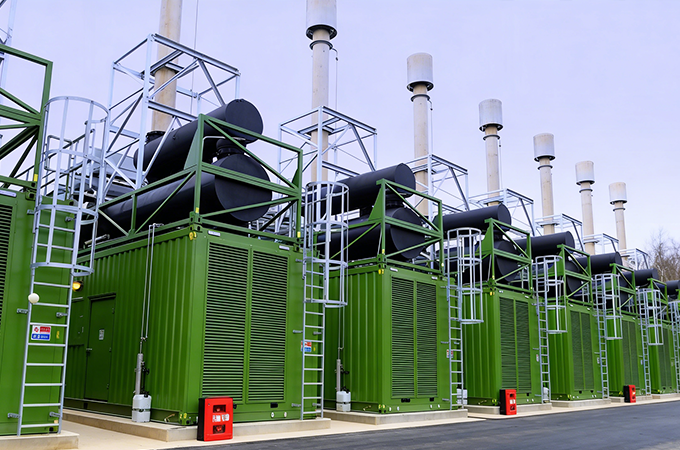
- Modular Containerized Power Stations: Tencent’s Tianjin data center uses prefabricated power modules, reducing deployment time by 60% and increasing power density by 20%.Key Implementation Points: Load classification management (only critical loads receive the highest level of protection), fuel reserve strategy (on-site storage for 72+ hours plus supply agreements).

1.2 Healthcare Facilities: Life Support System Guarantees
Challenge: Regulatory mandates directly impacting patient safety.
Solutions:
- EPSS (Emergency Power Supply System): Designed per NFPA 110 standards, separating life safety branches from equipment branches.
- Three-Power Source Architecture: Utility + Diesel Generation + Battery UPS. Beijing Union Medical College Hospital operating rooms use this design, with transfer times under 0.1 seconds.
- Distributed Power Station Design: Independent protection for main campuses and critical departments (ICU, operating rooms) to avoid single points of failure.
- Special Considerations: Strict noise control (below 55 dB), emission treatment (avoiding impact on air purification systems), regular load testing (minimum 30% load for 30 minutes monthly).
Chapter 2: Industrial and Commercial Application Solutions
2.1 Manufacturing: Addressing Complex Loads and Cost Optimization
Challenge: Large motor starting surges, power factor variations, high energy costs.
Solutions:
- Soft Starter + Generator Combinations: Equipping large injection molding machines and compressors with soft starters reduces starting current demands on generators.
- Automatic Power Factor Correction: Synchronous generators with automatic capacitor banks maintain power factor above 0.95.
- Combined Heat and Power (CHP) Solutions: Utilizing generator waste heat for production processes. An automotive factory project increased overall efficiency from 40% to 85%.
- Economic Analysis: By operating generators during peak pricing periods, a metal processing enterprise achieved annual electricity cost savings of 37%.
2.2 Commercial Buildings: Balancing Reliability and Economics
Challenge: Space constraints, environmental requirements, operational convenience needs.
Solutions:
- Silent Containerized Power Stations: Integrated soundproofing, ventilation, and fire protection systems. A Shanghai luxury mall rooftop station maintains noise below 65 dB.
- Gas Generator Priority: Natural gas units preferred in urban centers, eliminating fuel storage needs with cleaner emissions.
- Cloud Monitoring Platforms: Real-time IoT monitoring enables predictive maintenance, reducing on-site inspections by 70%.
Chapter 3: Off-Grid and Special Environment Solutions
3.1 Remote Areas: Integrated Energy System Construction
Challenge: Difficult fuel access, limited maintenance capabilities, harsh environments.
Solutions:
-
Hybrid Energy Microgrids: Diesel generator + PV + storage + energy management systems. An African village project reduced power costs from $0.8/kWh to $0.3/kWh.
-
Multi-Fuel Adaptability Design: Engine systems capable of handling low-quality diesel and biodiesel.
-
Remote Monitoring and Guidance: Satellite-connected expert systems with local personnel receiving maintenance guidance via AR devices.
3.2 Extreme Environments: Reliability-Enhanced Design
Challenge: High altitude, extreme cold/heat, corrosive environments.
Solutions:
-
Altitude Power Correction and Turbocharging: A Tibet base station uses turbocharging and high-altitude kits to maintain 90% of rated power.
-
Cold Climate Packages: Arctic research stations use electrically heated fuel tanks and coolant preheaters for starts at -50°C.
-
Comprehensive Corrosion Protection: Offshore platforms use IP56 protection, stainless steel fasteners, and triple-coating anti-corrosion systems.
Chapter 4: Core Technologies in Modern Power Station Solutions
4.1 Intelligent Control Systems
-
Parallel Operation and Load Sharing: Digital speed regulation and automatic synchronization keep load sharing deviation below 2% across multiple units.
-
Predictive Maintenance: Vibration analysis and lubricant monitoring provide 200-500 hour advance warning of potential failures.
-
Black Start Capability: Autonomous start without external power, crucial for grid restoration after collapse.
4.2 Environmental and Sustainability Technologies
-
Tiered Emission Control: DOC+DPF+SCR combinations meet strictest EPA Tier 4 Final/EU Stage V standards.
-
Noise Engineering Design: Triple control at source (low-noise engines), transmission (silencers, acoustic enclosures), and reception (architectural barriers).
-
Waste Heat Recovery Systems: Converting 40-45% waste heat to hot water or steam increases overall efficiency to over 80%.
Chapter 5: Solution Implementation Roadmap
5.1 Needs Analysis and Planning Phase
Key Steps:
-
Load characteristic analysis: Detailed load inventory distinguishing critical, important, and general loads.
-
Risk assessment: Determining acceptable outage times (from milliseconds to hours).
-
Site assessment: Space, ventilation, air intake/exhaust, fuel storage conditions.
-
Regulatory compliance: Environmental, fire safety, building code adherence.
5.2 Design Integration Phase
System Architecture Options:
-
Single unit: Suitable for small-medium scale, non-critical applications.
-
Parallel systems: Provide redundancy and scalability for large critical facilities.
-
Microgrid integration: Coordinated optimization with renewables and storage systems.
-
Capacity Calculation Principles: Consider future expansion (20-30% margin), motor starting currents, nonlinear load impacts.
5.3 Installation, Commissioning, and Operations Phase
Best Practices:
-
Prefabricated installation: Factory-tested modular power stations reduce on-site installation time by 50%.
-
Full load acceptance testing: Simulating real outage scenarios to verify system performance.
-
Operator training: Transitioning from “equipment operation” to “system management” capabilities.
-
Service agreement selection: Choosing appropriate maintenance contracts based on in-house technical capabilities.
Chapter 6: Cost Analysis and Return on Investment
6.1 Total Cost of Ownership (TCO) Model
-
Initial investment: Equipment procurement (45-60%), design and engineering (10-15%), installation (20-30%).
-
Operating costs: Fuel (50-70% of lifecycle cost), maintenance (3-5%/year), labor, emission treatment.
-
Hidden costs: Space occupancy, insurance, compliance costs.
6.2 ROI Calculation
-
Business Case: A data center using high-efficiency gas CHP.
-
Additional investment: $3.5 million over baseline solution.
-
Annual benefits: $850k electricity savings + $400k heating savings + $150k carbon trading revenue = $1.4 million.
-
Payback period: 2.5 years.
-
20-year NPV: +$18.5 million.
Chapter 7: Future Development Trends
7.1 Technology Integration
-
Digital twins: Virtual power stations synchronizing with physical systems to optimize operations.
-
Hydrogen backup: Hydrogen fuel cells entering commercial use as clean backup solutions.
-
AI optimization: Machine learning algorithms predicting load changes to optimize generator dispatch.
7.2 Business Model Innovation
-
Power-as-a-Service (PaaS): No capital investment, pay-for-availability models.
-
Shared backup capacity: Multiple regional users sharing power station resources to improve utilization.
-
Virtual power plant participation: Backup power participating in grid ancillary services, creating additional revenue.
From Emergency Equipment to Strategic Asset
Modern generator power station solutions have evolved from simple equipment procurement to multidisciplinary, lifecycle engineering systems. Successful solutions require optimal balance between reliability, economics, environmental responsibility, and operability. Whether for hospitals, data centers, factories, or remote communities, customized, intelligent, and sustainable power generation solutions are becoming core strategic assets for ensuring operational continuity and enhancing energy resilience.
In future energy systems, generator power stations will no longer be isolated backup units but organic components of smart microgrids, working in coordination with traditional grids, renewable energy, and storage systems to build more resilient, efficient, and cleaner energy futures. Selecting and implementing appropriate generator power station solutions responds not only to current needs but also proactively prepares for future challenges.
Ready for reliable power?
Reach out now to discuss your custom generator needs.